
How to Maximize Product Page Visibility on Major Marketplaces with Ecommerce SEO
In the hyper-competitive world of digital retail, launching a great product is only half the battle. If your target audience cannot find your items on massive retail networks, your sales will stall. To capture high-intent buyers, you must optimize your product detail pages using advanced ecommerce seo strategies specifically tailored for search algorithms.
Unlike standard search engines that focus on informational queries, marketplace search engines are transactional. They care about one thing: moving inventory. By aligning your optimization strategy with both search intent and algorithmic ranking factors, you can dramatically scale your organic reach.
Understanding Marketplace Search Algorithms vs. Standard Search Engine Optimization
To drive consistent traffic, you must first recognize that optimizing for retail platforms differs significantly from standard web search engine optimization.
The Core Focus of Internal Search Engines
Algorithms on major shopping networks prioritize search intent that leads directly to a transaction. While traditional search engines weigh external authority signs heavily, retail platforms focus heavily on performance metrics. They look at listing completeness, text relevance, historical click-through rates (CTR), and conversion rates. If your listing receives heavy traffic but fails to convert, the internal search engine will suppress your visibility, assuming your page is irrelevant to the query.
Why Conversions Dictate Organic Ranking
Conversions act as the lifeblood of ecommerce seo. A high conversion rate proves to the marketplace that your product satisfies the buyer’s query. Consequently, optimizing your layout, answering customer questions, and displaying clear visuals are just as critical to search positioning as embedding terms into your product titles.
Strategic Keyword Research for Online Stores
Before adjusting any copy, you need to uncover exactly how your target customers search for your items. Missing the right phrases means losing sales to competitors who have better mapped their product information.
High-Intent Keywords = Root Keyword + Intent Modifier (e.g., “Waterproof”) + Specifications (e.g., “10L”)
Mapping Short-Tail and Long-Tail Search Terms
Your optimization foundation relies on a balanced mix of search terms:
Short-Tail Terms: Broad phrases with high search volume (e.g., “running shoes”). These are competitive but necessary for category alignment.
Long-Tail Terms: Highly specific phrases with lower volume but immense purchase intent (e.g., “women’s waterproof trail running shoes size 7”).
Focusing your initial efforts on long-tail variations allows your listings to capture qualified buyers who are ready to purchase immediately, establishing the early sales history required to rank for broader terms.
Analyzing Competitor Metadata and Search Gaps
Study the highest-ranking sellers in your category. Identify the descriptive phrases, specific attributes, and technical specifications they place in their primary titles and item descriptions. Pay attention to consumer reviews on competitor pages; buyers frequently use natural language that differs from brand jargon. Integrating these customer-generated phrases into your keyword map uncovers highly profitable search gaps.
On-Page Optimization Framework for Product Detail Pages
With your search terms selected, systematically inject them across your page elements without compromising readability.
Designing Titles with High Click-Through Rates
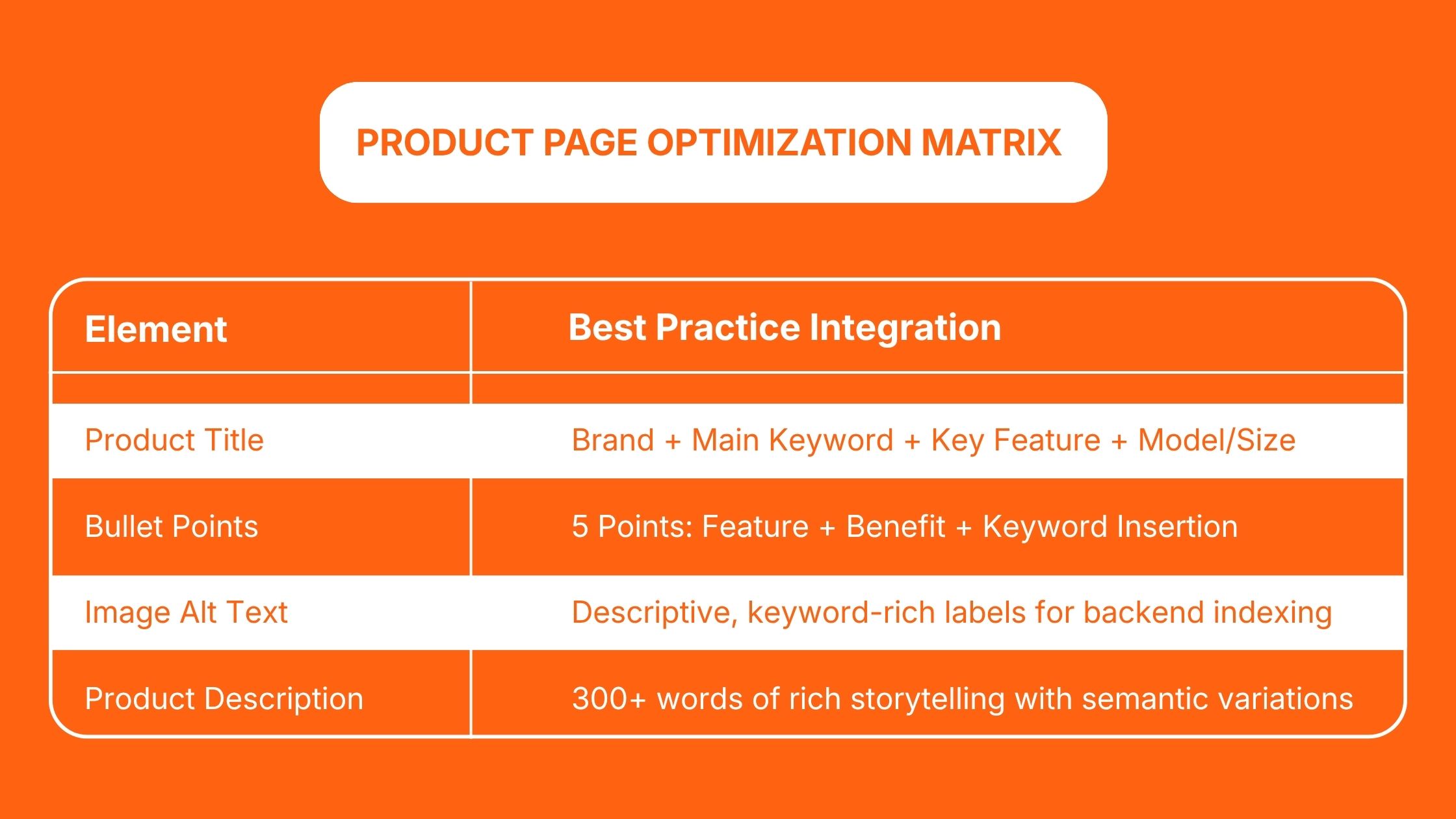
Your title is the most vital asset for ecommerce seo. It must satisfy both the indexing algorithm and the human shopper skimming search results. Keep your structure clean: start with your brand name, follow immediately with your primary target keyword, and include distinguishing details like color, material, or size. Avoid stuffing phrases; clarity always drives higher click-through rates.
Crafting Bullet Points for Conversions and Algorithms
Bullet points should highlight real-world benefits while addressing structural indexing requirements. Use your top five bullet points to answer common customer objections. Introduce secondary keywords naturally at the beginning of your bullet headers to catch the buyer’s eye and reinforce relevancy signals to the platform’s crawler.
Writing Long-Form Descriptions and Backend Terms
The main body of your description should read as an explicit sales page. Elaborate on use cases, material durability, and warranty specifics. Additionally, take full advantage of hidden backend search terms fields. Fill these hidden fields with alternative spellings, synonyms, and related regional variations that do not fit neatly into your consumer-facing copy.
Leveraging Visual Media and Technical Attributes
Text optimization alone will not guarantee sustained visibility. High-fidelity visual elements and precise backend catalog structuring are necessary to maximize your return on investment.
Image Optimization and Alternative Text Formatting
High-resolution images directly impact your conversion metrics, which indirectly boosts your search standing. Ensure your primary image complies with platform requirements, such as clean white backgrounds. When uploading assets, utilize descriptive image alt text containing your target keywords to assist the system’s computer vision algorithms in categorizing your item accurately.
Selecting Complete Product Attributes and Categories
Misclassifying your product will instantly kill your traffic. Fill out every single technical attribute field provided by the marketplace dashboard, including dimensions, weights, and materials. Many shoppers rely entirely on sidebar navigation filters to narrow their search results; if you fail to declare your color or material attribute, your page will vanish from filtered views.
The Role of Social Proof and Performance Metrics
A beautifully optimized page will drop in rankings if it lacks strong social proof and operational efficiency.
Generating High-Quality Customer Reviews
The main body of your description should read as an explicit sales page. Elaborate on use cases, material durability, and warranty specifics. Additionally, take full advantage of hidden backend search terms fields. Fill these hidden fields with alternative spellings, synonyms, and related regional variations that do not fit neatly into your consumer-facing copy.
Maintaining Optimal Inventory Levels and Fulfillment Speeds
Marketplaces penalize out-of-stock listings because an unfulfilled order damages the consumer experience. Maintain buffer inventory and ensure rapid handling times. Platforms prioritize sellers utilizing native fulfillment networks or verified express shipping methods, frequently rewarding them with prominent visibility boosts.
Summary Checklist for Advanced Product Page Visibility
To ensure your product pages remain competitive and fully visible, audit your listings regularly against this operational checklist:
[ ] Inject the primary ecommerce seo keyword into the first 60 characters of the product title.
[ ] Map out five high-impact bullet points that pair features with user benefits.
[ ] Complete every technical attribute field in your seller backend to capture filter-driven traffic.
[ ] Optimize image filenames and alternative text with descriptive, semantic search terms.
[ ] Set up automated post-purchase workflows to maintain a steady stream of fresh customer reviews.
About The Author

Stephanne Alfaro
administrator
Stephanne Alfaro is an SEO specialist and content strategist based in Cebu, Philippines, with 5+ years of experience in keyword research, on-page SEO, link building, and content strategy for clients in the US, Canada, Australia, and the Philippines.